Greece Travel Guide: Everything You Need to Know Before You Go
Greece is one of those rare destinations that lives up to every expectation — ancient ruins rising above sea-blue horizons, whitewashed villages spilling down volcanic cliffs, and food so good you will find yourself planning your next meal before you have finished the current one. If you are a US traveler dreaming of your first Greek adventure, this complete Greece travel guide covers everything you need — from visa rules and entry requirements to the best islands, top destinations, budget tips, and the insider knowledge that turns a good trip into an unforgettable one.
- Why Greece Should Be Your Next Trip
- Visa and Entry Requirements for US Travelers
- Best Time to Visit Greece
- Top Destinations in Greece
- The Best Greek Islands
- How to Get Around Greece
- Greek Food and Drink Guide
- Greece Travel Budget: What to Expect
- Practical Travel Tips for Greece
- Frequently Asked Questions
Why Greece Should Be Your Next Trip
There are destinations that disappoint you when you finally arrive, and then there is Greece — a country that somehow exceeds even the most travel-worn expectations. It is the only place in the world where you can stand inside a 2,500-year-old temple in the morning, eat the freshest grilled octopus on a sun-bleached waterfront at noon, swim in water so clear it looks photoshopped in the afternoon, and watch a sunset that turns the entire sky gold and pink by evening.
Greece remains one of the most popular international destinations for American travelers, and with good reason. US citizens do not need a visa to visit Greece, the country uses euros and is one of the more affordable destinations in Western Europe, English is widely spoken in tourist areas, and the variety of experiences on offer — from ancient history to island beaches, hiking to luxury resorts — means there is a version of Greece that suits every type of traveler.
Whether you are planning a romantic honeymoon in Santorini, a family beach holiday in Crete, a history-driven city break in Athens, or a backpacker’s island-hopping adventure through the Cyclades, this guide gives you everything you need to plan it right.
Visa and Entry Requirements for US Travelers
Good news first: US citizens do not need a visa to visit Greece. As part of the Schengen Area, Greece allows American passport holders to enter and stay for up to 90 days within any 180-day period without requiring a visa. This 90-day allowance covers tourism, leisure, visiting family, and short business trips.
What You Need at the Border
- A valid US passport — it must be valid for at least 3 months beyond your planned departure date from Greece
- Proof of sufficient funds — immigration officers may ask, though this is rarely checked in practice
- A return or onward ticket — not always requested but recommended to have
- Travel insurance — not mandatory but strongly recommended (more on this below)
The 90/180-Day Schengen Rule — What It Really Means
This is one of the most misunderstood rules in European travel. The rule means you can spend a maximum of 90 days in the entire Schengen Area — not just Greece — within any rolling 180-day period. So if you spent 30 days in Italy and 30 days in France before arriving in Greece, you only have 30 days of visa-free time left for Greece. Plan your itinerary carefully if Greece is part of a larger European trip.
Starting in late 2026, US citizens will need to obtain an ETIAS (European Travel Information and Authorization System) authorization before visiting Greece and other Schengen countries. This is not a visa — it is a simple online pre-travel authorization similar to the US ESTA for visitors to America. It will cost approximately €20 and will be valid for 3 years. ETIAS is not yet in effect at the time of writing, but check official sources before your trip if you are traveling in late 2026 or beyond.
Entry/Exit System (EES) — Also Coming in 2025–2026
Greece and the wider Schengen Area are also rolling out a new Entry/Exit System (EES) that will replace manual passport stamping with digital biometric data collection — fingerprints and a facial image — to automatically track days spent in the Schengen zone. This makes it harder to accidentally overstay and easier for border authorities to verify compliance with the 90-day rule. Expect this system to be fully operational by 2026.
Always carry a printed or digital copy of your return flight ticket and accommodation bookings when passing through Greek passport control, even though they are rarely asked for. If you are island-hopping and your final port of departure is different from your entry point, this is especially useful to have on hand.
✈️ Find the Cheapest Flights to Greece
Compare hundreds of airlines and booking sites to find the best deal on flights to Athens, Santorini, Mykonos, and more.
Best Time to Visit Greece
Greece is a year-round destination but the experience varies dramatically by season. The short answer: the best time to visit Greece is May to June or September to October — the shoulder seasons when the weather is warm, the crowds are manageable, and prices are significantly lower than the peak summer months.
Spring (April to June) — The Sweet Spot
April through June is arguably the best time to visit Greece for most travelers. Temperatures are warm and pleasant — ranging from around 65°F to 82°F — wildflowers are in bloom across the countryside, the ancient ruins are not yet baking in the summer heat, and the tourist infrastructure is fully operational without the suffocating July and August crowds. Hotel prices are 30 to 50 percent lower than peak season, and you will actually be able to get a reservation at the restaurants you want.
Summer (July to August) — Peak Season
Summer is the most popular time to visit and the most expensive by far. July and August see temperatures regularly hitting 95°F to 104°F on the islands, accommodation prices at their highest, ferries and popular restaurants fully booked weeks in advance, and the famous sunset viewpoint in Oia packed with hundreds of tourists waiting hours for the same photograph. That said, if the pure beach experience in full Mediterranean summer sun is what you are after — and the energy of a bustling, lively Greece — peak season delivers exactly that.
Autumn (September to October) — Hidden Gem Season
September is a travelers’ secret. The sea is at its warmest of the year — retaining all the heat of summer — the light is golden and soft, the crowds have thinned considerably, prices drop, and the harvest season brings Greece’s food and wine scene to its absolute peak. October is excellent for mainland Greece and Athens but some island businesses begin closing down by late October as the season ends.
Winter (November to March) — For the Adventurous
Greece in winter is a largely undiscovered experience. Athens is vibrant, alive, and genuinely affordable — museums are quiet, restaurants serve locals rather than tourists, and historic sites are blissfully uncrowded. However, most of the Greek islands significantly reduce services from November through March, and some smaller islands effectively shut down entirely. If you are going in winter, base yourself in Athens, Thessaloniki, or Crete — the largest island and the one that maintains services year-round.
Top Destinations in Greece
Greece is far more than just its famous islands. From the living, breathing ancient capital of Athens to the otherworldly monasteries of Meteora and the Venetian-influenced streets of Thessaloniki, the Greek mainland alone could fill two weeks of extraordinary travel. Here are the destinations every traveler to Greece should know about.
Athens — Where Ancient History Meets Modern Life
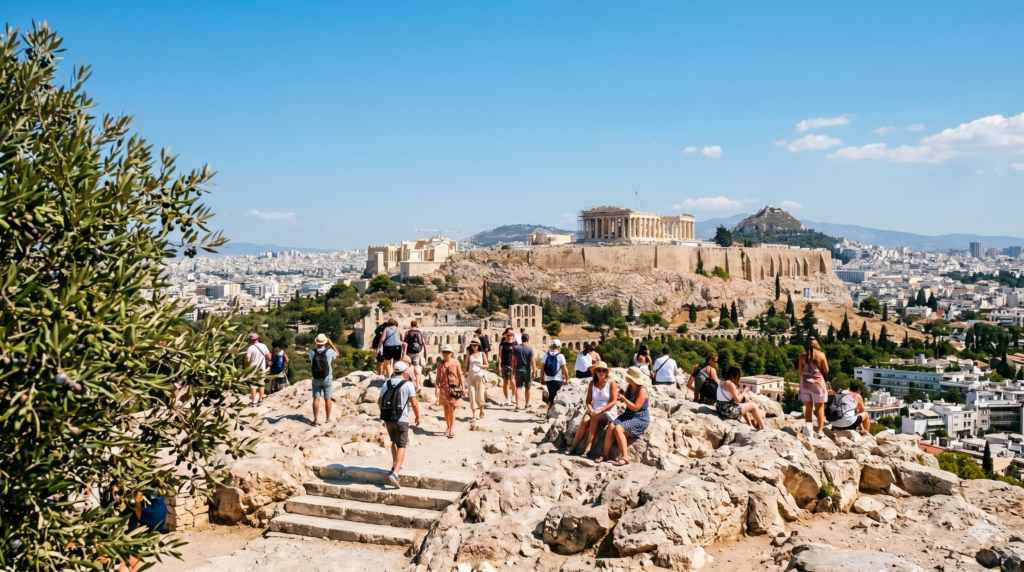
Almost every Greece trip starts in Athens, and rightfully so. The city is home to the Acropolis — the most iconic ancient monument in the Western world — and surrounding it is a layered, chaotic, endlessly fascinating metropolis that has been continuously inhabited for over 3,000 years. Do not make the mistake of treating Athens as just a stopover. Give it at least two full days.
The Acropolis Museum is essential — it houses the original sculptures and friezes from the Parthenon and contextualises the hill you will have just climbed in extraordinary detail. The Plaka neighborhood at the foot of the Acropolis is the oldest continuously inhabited area of Athens and the best place for a slow morning coffee and a wander through narrow marble-paved streets. For the best free view of the Acropolis, walk up Areopagus Hill just to the west — no ticket required and arguably a better angle than the Acropolis itself.
Book your Acropolis tickets online in advance — especially in summer when queues can stretch to 90 minutes. The multi-site ticket (€30) covers the Acropolis plus six other archaeological sites including the Ancient Agora and the Theatre of Dionysus, making it exceptional value.
Santorini — The One That Needs No Introduction
No destination on earth is more photographed than Santorini’s caldera edge — and visiting in person confirms that no photograph actually does it justice. The island sits in the southern Cyclades on the rim of an ancient volcanic crater, with the towns of Oia, Fira, and Imerovigli clinging to the clifftops above a 300-metre drop to the sea below. The sunsets here are genuinely among the most spectacular natural phenomena you will witness in your lifetime.
Santorini is expensive — one of the priciest destinations in Greece — but worth budgeting for at least two or three nights. Stay in Oia or Imerovigli for the classic caldera view. The black sand beach at Perissa offers far better value for accommodation than the clifftop towns without sacrificing the island experience. Take the Fira to Oia hiking trail (about 10km) for the most spectacular free activity on the island.
Crete — Greece’s Largest and Most Diverse Island
Crete is an island that could comfortably fill an entire two-week holiday on its own. It is Greece’s largest island and combines beach life, ancient Minoan civilizations (the oldest in Europe), dramatic mountain gorges, and some of the country’s finest food and wine in one extraordinary package. The Palace of Knossos near Heraklion is a 3,500-year-old Minoan palace and one of the most significant archaeological sites in Europe. The Samaria Gorge in the west is a 16km hike through one of Europe’s longest gorges — an unmissable adventure for active travelers. The beaches of Elafonisi and Balos in western Crete regularly rank among the most beautiful in the world.
Meteora — The Most Dramatic Sight in Mainland Greece
About four hours by train north of Athens, the monasteries of Meteora are one of Greece’s most breathtaking and underrated experiences. Sixth-century Byzantine monasteries perch impossibly on the tops of enormous rock pillars that rise hundreds of metres above the valley floor. Six monasteries are still active and open to visitors. The site was originally accessed only by rope ladders and winches — today there are steps carved into the rock. Come at sunrise or sunset for photography that will make your Instagram feed permanently jealous.
Thessaloniki — Greece’s Second City and Culinary Capital
Often overlooked by international travelers rushing to the islands, Thessaloniki in northern Greece is one of the most underrated cities in Europe. It has an extraordinary food scene — widely considered the gastronomic capital of Greece — a buzzing café culture, Byzantine churches, Roman ruins, and a waterfront promenade that rivals anywhere in the Mediterranean. It is also significantly cheaper than Athens and the islands. If you have the time, a two-day detour to Thessaloniki rewards generously.
The Best Greek Islands — Which One Is Right for You?
Greece has over 6,000 islands, around 230 of which are inhabited. Choosing between them is one of the greatest pleasures — and greatest challenges — of planning a Greek trip. The right island depends entirely on what kind of traveler you are. Here is an honest breakdown of the top islands and who they suit best.
| Island | Best For | Vibe | Budget Level |
|---|---|---|---|
| Santorini | Honeymooners, couples, photographers | Romantic, dramatic, iconic | $$$$ |
| Mykonos | Party lovers, LGBTQ+ travelers | Glamorous, lively, fashionable | $$$$ |
| Crete | Families, beach lovers, history fans | Diverse, authentic, adventurous | $$ |
| Rhodes | History buffs, families, beach lovers | Medieval, lively, sunny | $$ |
| Corfu | Nature lovers, couples, families | Lush, Venetian-influenced, relaxed | $$ |
| Paros | All types, first-time island visitors | Balanced, beautiful, friendly | $$$ |
| Naxos | Budget travelers, foodies, hikers | Authentic, laid-back, off the beaten path | $$ |
| Milos | Couples, nature lovers, divers | Dramatic, volcanic, uncrowded | $$$ |
Island-Hopping: How to Do It Right
One of the greatest joys of Greece is island-hopping — taking ferries between islands and experiencing two or three different environments in one trip. The most popular island-hopping routes for first-timers start in Athens (Piraeus port) and move through the Cyclades: Athens → Mykonos → Paros or Naxos → Santorini is a classic 10-day route that covers the best of the Cyclades while not spending your entire budget in one place.
Ferry tip: Book ferries in advance during July and August — they sell out. Use Ferryhopper or Greek Ferries to compare routes and prices. High-speed ferries cost more but cut travel time significantly. The overnight ferry from Athens to Santorini, for example, takes around 8 hours — book a cabin and save a night of accommodation costs.
ℹ️ Ferry vs. Flight Between Islands: Flying between islands is sometimes faster but rarely cheaper when you factor in getting to and from the airport. Ferries drop you right into the port of most island towns, making them the preferred and more scenic option for inter-island travel. Reserve flights only for long hauls — for example, Athens to Crete or Crete to Rhodes.
🏨 Find the Best Hotels in Greece
Compare prices across hundreds of sites for hotels in Santorini, Athens, Crete, Mykonos, and beyond.
How to Get Around Greece
Getting around Greece is part of the adventure — and understanding your options before you go will save you significant time, money, and frustration once you arrive.
Getting to Greece
The main international gateway for US travelers is Athens International Airport (ATH), also known as Eleftherios Venizelos. Most major US carriers offer connecting flights to Athens, with common layovers in London, Frankfurt, Amsterdam, and Istanbul. Flight times from the US East Coast are typically 10 to 12 hours with one connection, and from the West Coast around 13 to 16 hours. Direct flights from New York to Athens are available seasonally. Thessaloniki (SKG) and Heraklion in Crete (HER) also receive European connections if you want to start your trip outside Athens.
Getting Around the Mainland
Within mainland Greece, intercity buses (KTEL) are the most affordable way to travel between cities and are reliable and comfortable. The Athens to Thessaloniki route takes about 5 to 6 hours and costs around €30 to €45. Trains connect Athens to Thessaloniki and other mainland cities — the high-speed service takes about 4 hours and is a comfortable, scenic option. Renting a car is highly recommended for exploring mainland Greece beyond the major cities, particularly for Meteora, the Peloponnese, and rural Crete. Roads are generally good, driving is on the right, and most international US driving licences are accepted.
Getting Between Islands: Ferries
Ferries are the heartbeat of Greek island life and one of the most enjoyable parts of any Greek trip when you embrace them properly. Piraeus port in Athens is the main hub for Aegean island ferries. Most Cyclades islands (Mykonos, Santorini, Paros, Naxos, Milos) are reached from Piraeus. Ionian islands (Corfu, Kefalonia, Zakynthos) are reached by ferry from mainland ports like Patras and Igoumenitsa.
- High-speed (catamaran) ferries — fast, more expensive, can be rocky in rough weather
- Conventional ferries — slower but significantly cheaper, great for overnight journeys
- Seaways and local ferries — for short hops between neighbouring islands
Book all ferries for July and August at least 4 to 6 weeks in advance — especially overnight sailings and popular routes like Athens to Santorini and Mykonos to Santorini. Use Ferryhopper.com to compare all operators and prices in one place. Always arrive at the port at least 30 minutes before departure, as Greek ferries are punctual about departing on time.
Getting Around the Islands
On most islands, you have three realistic options: renting a scooter or ATV (the most popular and fun option — usually €15 to €25 per day), renting a car (better for larger islands like Crete and Rhodes, typically €30 to €60 per day), or relying on local buses (KTEL) which connect major towns and beaches on most larger islands. Taxis are available on larger islands but can be expensive and scarce during peak summer. Rideshares like Uber are available in Athens but not on the islands.
Greek Food and Drink — What to Eat and Where
Greek food is one of the world’s great culinary traditions, and yet it is consistently underestimated by travelers who arrive expecting just moussaka and gyros. Greek cuisine is fresh, seasonal, locally sourced, and profoundly regional — what you eat in Crete is different from what you eat in Athens, which is different from what you eat on a Cyclades island. Exploring this variety is one of the true pleasures of Greek travel.
Essential Greek Dishes to Try
- Spanakopita — flaky phyllo pastry stuffed with spinach and feta cheese. Found at every bakery (fournos) in the country and the best 90-cent breakfast you will ever have.
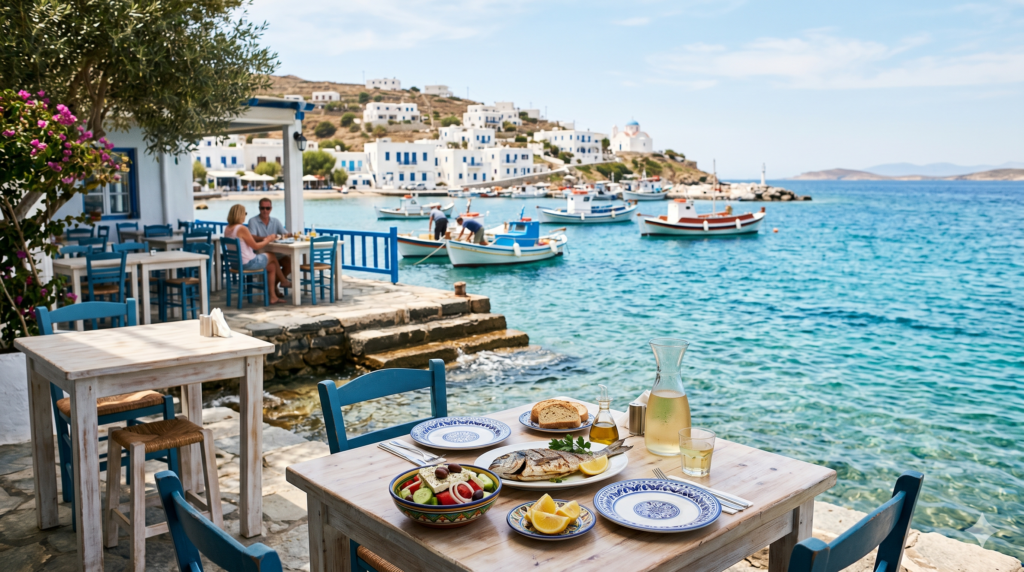
- Fresh grilled octopus — the ultimate Greek waterfront meal. Hung to dry in the sun outside tavernas, then grilled over charcoal and drizzled with olive oil and lemon.
- Saganaki — fried cheese (usually kefalograviera or graviera), served piping hot and crispy. Often flambéed tableside with an enthusiastic cry of “Opa!”
- Souvlaki and gyros — Greece’s beloved street food. Souvlaki is grilled meat on a skewer; a gyros pita wraps the meat in flatbread with tomatoes, onion, and tzatziki. Budget €2 to €4 per piece.
- Horiatiki (Greek salad) — the real version uses ripe tomatoes, cucumber, red onion, olives, and a thick slab of feta — no lettuce, ever. Always dressed with olive oil, never with dressing from a bottle.
- Fresh fish and seafood — always order the daily catch at waterfront tavernas. Ask what arrived that morning rather than pointing at the menu. Priced by the kilogram — always ask the weight before ordering.
- Loukoumades — warm honey-drizzled doughnut balls dusted with cinnamon. Greece’s most addictive street snack.
- Local wine and ouzo — Greek wine has improved enormously in recent decades and is exceptional value. Assyrtiko from Santorini is one of the world’s great white wines. Ouzo — the anise-flavored spirit — is drunk slowly, diluted with cold water which turns it milky white, always with meze (small plates) alongside.
Where to Eat — Taverna vs. Tourist Trap
The golden rule: if a restaurant has a man standing outside waving a laminated menu at you, keep walking. If a restaurant has its menu only in Greek and fills up with locals at 9pm, sit down immediately. Family-run tavernas (tavernes) are always the best bet — portions are enormous, prices are honest, and the food tastes of real Greek cooking rather than the sanitised version designed for tourist palates.
Meal times in Greece follow Mediterranean rhythms: lunch is eaten late (1pm to 4pm) and dinner is eaten very late by American standards (9pm to 11pm). If you show up at a restaurant at 6pm, you will be the only customer and the kitchen may not even be fully running. Embrace the Greek schedule and your evenings will unfold beautifully.
🎭 Book Tours and Experiences in Greece
From Athens food tours and Acropolis guided visits to Santorini sailing trips and Crete wine experiences — book top-rated activities with free cancellation.
Greece Travel Budget: What to Expect
Greece is one of the most affordable countries in Western Europe, though costs vary enormously depending on where you stay, when you travel, and how you choose to experience the country. Here is an honest breakdown by budget type.
Budget Traveler
$60–$90/day- Hostel dorm or basic studio
- Street food and bakery meals
- Local tavernas for one sit-down meal
- Conventional ferries, local buses
- Free beaches and hiking
- Avoid Santorini and Mykonos
Mid-Range Traveler
$120–$200/day- 3-star hotel or Airbnb
- Mix of tavernas and cafés
- Two sit-down meals daily
- High-speed ferries
- A few paid tours or activities
- Mix of islands including Santorini
Luxury Traveler
$300–$600+/day- Caldera-view hotel in Santorini
- Upscale restaurants with wine
- Private tours and experiences
- Domestic flights between islands
- Infinity pool, spa access
- Helicopter transfers available
Typical Costs in Greece (2025)
- Coffee (frappe or espresso): €2 to €4
- Gyros pita: €2.50 to €4
- Lunch at a local taverna (per person): €10 to €20
- Dinner at a mid-range restaurant (per person with wine): €25 to €50
- Beer at a bar: €3 to €6
- Acropolis entrance ticket: €20 (or €30 for multi-site pass)
- Ferry Athens to Santorini (conventional): €35 to €50
- Ferry Athens to Santorini (high-speed): €60 to €90
- Budget hotel on smaller islands (per night): €50 to €90
- Caldera-view hotel in Santorini (per night): €200 to €800+
- Scooter rental (per day): €15 to €30
ℹ️ Money in Greece: Greece uses the Euro (€). Credit and debit cards are widely accepted in tourist areas but carry cash on smaller islands and in traditional villages. ATMs are widely available but be aware of ATM fees — withdraw larger amounts less frequently to minimise charges. Tipping is appreciated but not obligatory: round up the bill or leave 1 to 2 euros at a café, 5 to 10 percent at a restaurant for good service.

Practical Travel Tips for Greece
These are the things that experienced Greece travelers wish someone had told them before their first trip — the small practical details that make the difference between a smooth adventure and unnecessary frustration.
Pack Smart for Greece
- Comfortable walking shoes are essential — Greece involves a lot of cobblestone streets, ancient stone paths, and steep hillside steps. Good footwear is not optional.
- Bring a power adapter — Greece uses Type C and Type F plugs (the two-round-pin European standard) at 230V. US devices need an adapter.
- Light layers for evenings — evenings on the islands can be surprisingly cool, especially from late September onwards and during the shoulder seasons.
- Reef-safe sunscreen — the Greek government has introduced regulations around reef protection in some marine areas. Bring biodegradable sunscreen.
- A modest cover-up for churches and monasteries — women should cover shoulders and knees, men should avoid shorts at most religious sites. Many sites lend scarves at the entrance but bringing your own is easier.
Health and Safety in Greece
Greece is one of the safest countries in Europe and generally very safe for solo travelers, women, families, and LGBTQ+ visitors. The main things to be aware of are minor pickpocketing in crowded tourist areas of Athens (around the Monastiraki flea market and on the Metro) and the usual beach bag awareness. Tap water is safe to drink in Athens and most cities, but on some islands the tap water is desalinated or of variable quality — locals will tell you if bottled water is recommended.
Travel insurance is strongly recommended. Greece has both public and private hospitals — private clinics in tourist areas are of high quality but expensive without insurance. The European Health Insurance Card (EHIC) is not available to US citizens, so comprehensive travel insurance covering medical evacuation is the sensible choice for Americans visiting Greece.
Connectivity — Staying Online in Greece
WiFi is excellent in hotels, cafés, and restaurants across Greece, including on the islands. For mobile data, the easiest option for US travelers is to purchase a local SIM card on arrival at Athens airport — major operators include Cosmote, Vodafone Greece, and Wind. A data SIM with 10GB to 20GB typically costs €10 to €20 for a 30-day period. Alternatively, check whether your US carrier includes Greece in its international data plan — T-Mobile and Google Fi both offer reasonable international data coverage.
Language Tips
English is widely spoken in tourist areas, hotels, and restaurants throughout Greece — you will rarely struggle to communicate in any of the major destinations. That said, a few words of Greek go an enormous way in creating warmth and goodwill with locals. Efharisto (thank you), Parakaló (please/you’re welcome), and Yiasas (hello/cheers) will earn you genuine smiles everywhere you go. In smaller villages and markets away from tourist centres, Greek is often the only language spoken.
Cultural Etiquette
- Greeks eat late — do not arrive at a restaurant before 8:30pm and expect to be the earliest customer even then.
- The head wobble that looks like “no” in Greece actually means “yes.” A sharp upward nod of the head means “no.” This will confuse you at least once.
- Haggling is not part of Greek culture in shops or restaurants — prices are set and negotiating is considered rude.
- Sunbathing topless is common and accepted on most Greek beaches but nudity is only permitted on designated nudist beaches.
- Greeks are extraordinarily hospitable — if a local insists on buying you a coffee or a glass of ouzo, accepting graciously is the right response.
Book your Santorini accommodation, any ferry tickets for July and August travel, and any Athens attractions you absolutely cannot miss (the Acropolis, the Acropolis Museum) at least 6 to 8 weeks before your trip. Everything else in Greece can be figured out as you go — the country rewards spontaneity and the unexpected detour is often the best part of any Greek trip.
Always check the US State Department’s Greece Travel Advisory at travel.state.gov before your trip for the most current safety information, entry requirements, and any region-specific advisories. At the time of writing, Greece carries a Level 1 advisory — “Exercise Normal Precautions” — the lowest level. Early 2025 saw some seismic activity near Santorini which temporarily affected visitor numbers; conditions returned to normal quickly, but checking current advisories before booking is always good practice.
🛡️ Get Greece Travel Insurance
Protect your investment with comprehensive travel insurance covering medical, cancellation, and evacuation. Highly recommended for all international trips.
Frequently Asked Questions About Visiting Greece
No. US citizens can visit Greece visa-free for up to 90 days within any 180-day period for tourism or business. Your passport must be valid for at least 3 months beyond your planned departure date from Greece. Note that starting in late 2026, US citizens will need an ETIAS online travel authorization (not a visa — a simple online pre-approval costing around €20) before visiting Greece. ETIAS is not yet required at the time of writing.
The best time to visit Greece is May to June or September to October. These shoulder seasons offer warm, sunny weather (75°F to 86°F), significantly lower prices than peak summer, and far more manageable crowds. July and August are the hottest and most expensive months, with temperatures regularly hitting 95°F to 104°F on the islands. September is a particular sweet spot — the sea is at its warmest of the year, the light is golden, and the tourist rush has subsided.
Greece suits all budgets. Budget travelers can get by on $60 to $90 per day staying in hostels or basic studios, eating street food and local tavernas, and using conventional ferries. Mid-range travelers typically spend $120 to $200 per day with 3-star accommodation, restaurant meals, and high-speed ferries. Luxury travelers in Santorini caldera hotels with upscale dining should budget $300 to $600 or more per day. Santorini and Mykonos are significantly more expensive than the rest of Greece — budget accordingly.
For a first visit to Greece, 10 to 14 days is ideal. A solid 10-day itinerary might look like: 2 days Athens, 1 day travel/Mykonos arrival, 2 days Mykonos, 1 day Paros or Naxos, 3 days Santorini, 1 day return Athens. If you want to include Crete, budget 14 days minimum. Two weeks allows you to experience Athens, two or three islands, and still have enough time to slow down and actually enjoy each place rather than just ticking it off.
Yes, Greece is generally very safe for solo female travelers and is one of the more welcoming destinations in Europe for women traveling alone. The main sensible precautions are the same as any international destination — be aware of your belongings in crowded tourist areas, avoid poorly lit streets late at night in unfamiliar areas, and trust your instincts. Greek culture is warm and hospitable, and solo female travelers consistently report feeling comfortable and safe throughout the country. The Greek islands in particular have a relaxed, community-oriented atmosphere that makes solo travel a genuinely enjoyable experience.
For a first-time visitor, Santorini, Crete, or Paros are the best starting points. Santorini offers the iconic Greek island experience but is expensive — budget accordingly. Crete is the best choice if you want beaches, history, food culture, and hiking all in one place at a reasonable price. Paros hits a perfect middle ground — beautiful, genuinely Greek in character, not overly commercialised, and a good ferry hub for island-hopping further into the Cyclades. Avoid starting with Mykonos if budget is a concern — it is one of the most expensive islands in Greece.
Final Thoughts: Is Greece Worth It?
Greece is one of those rare places that justifies every cent, every hour of planning, and every flight connection to get there. The combination of ancient history, extraordinary natural beauty, remarkable food, genuine warmth from its people, and a variety of experiences that suits every type of traveler makes it one of the truly unmissable destinations on the planet.
Go in May or September, book your Santorini accommodation early, eat where the locals eat, take the slow ferry at least once, and allow yourself to get genuinely lost in the backstreets of Athens or the whitewashed villages of a smaller island you had never heard of before you booked. That is where Greece gives you its best.
Find Greece Hotels on Booking.com →